
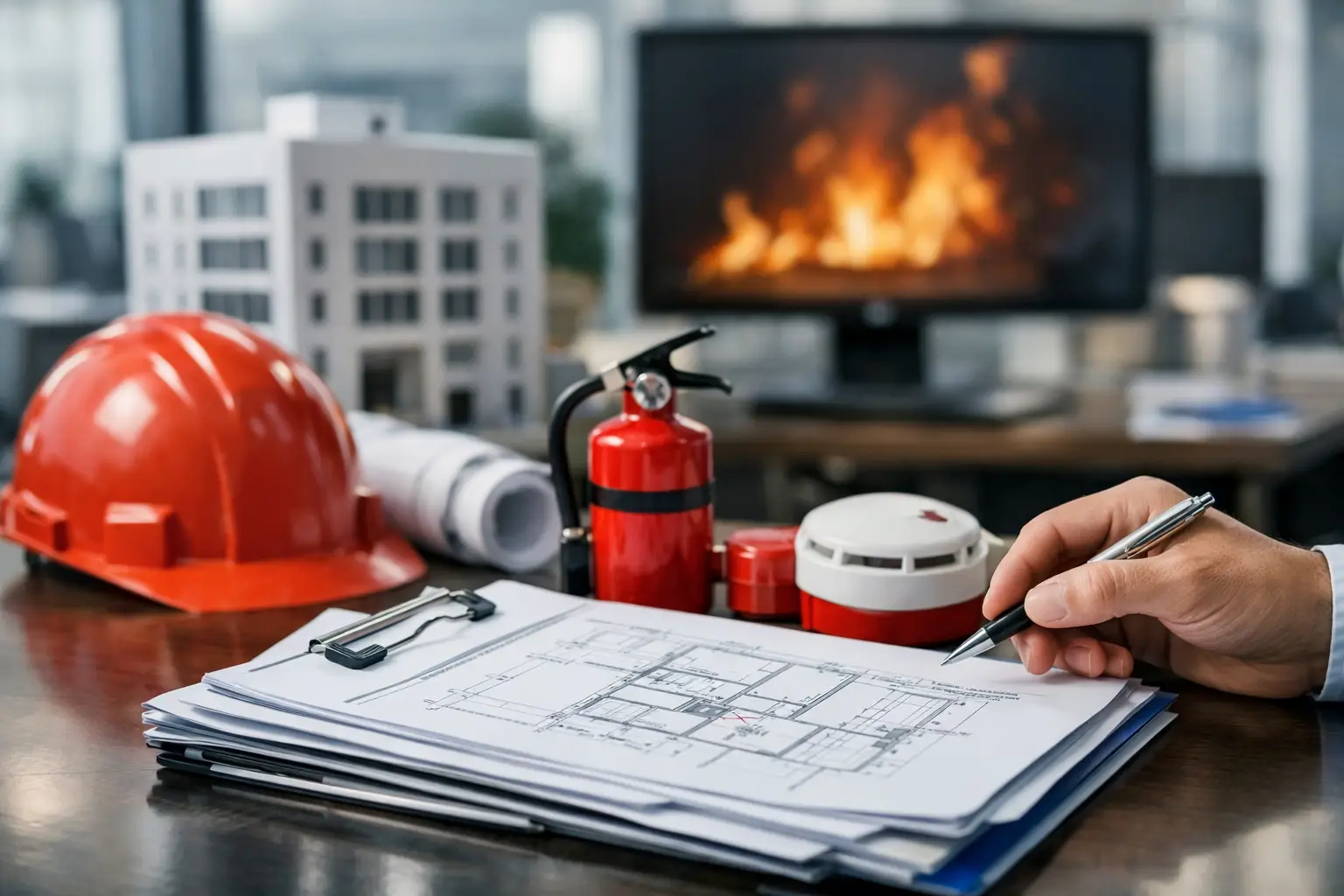
A QCDD file rarely gets delayed because of one dramatic mistake. More often, approvals slow down because a submission is missing a drawing, a calculation, a product data sheet, or a clear match between the design package and the authority requirement. If you are asking what documents are needed for QCDD approval, the practical answer is this: the exact set depends on your project scope, but the submission must show a complete, coordinated, and code-compliant fire and life safety package.
For owners, tenants, developers, and project managers, that distinction matters. There is no single universal checklist that fits every villa, warehouse, tower, restaurant, clinic, or office fit-out. QCDD reviews what is being built, how it will be occupied, what systems are proposed, and whether the submitted documents prove compliance clearly enough for approval without repeated comments.
What documents are needed for QCDD approval in most projects?
In most cases, QCDD approval requires a combination of administrative documents, design drawings, technical calculations, material and equipment submittals, and supporting certificates. The authority is not only checking whether fire protection systems exist. It is checking whether the entire fire and life safety strategy is documented, coordinated, and suitable for the building use.
A typical submission starts with basic project information. That usually includes the application form, project identification details, and the approved architectural package or reference drawings that establish the building layout and occupancy. If the fire and life safety design is being submitted for a fit-out rather than a new building, the package also needs to show the relationship between the base building systems and the tenant scope.
From there, the technical package becomes the critical part of the review. Fire alarm drawings, firefighting drawings, emergency lighting layouts, exit signage plans, smoke management details if applicable, and reflected coordination with architectural and MEP drawings are often required. In parallel, QCDD may expect hydraulic calculations, voltage drop calculations, battery calculations, equipment schedules, cause-and-effect logic, and system specifications depending on the system type.
The principle is straightforward. If a life safety element appears on the drawings, the submission should also include the technical basis that proves it works as designed.
The core document categories QCDD typically reviews
1. Authority and project identification documents
Every file needs a clear administrative front end. This often includes the project application, owner or tenant identification, plot or building reference information, consultant details, and any prior approvals relevant to the submission stage. For renovation and fit-out work, lease documents or authorization from the property owner may also be required depending on the building and approval pathway.
These documents may seem routine, but they establish the legal and procedural basis of the submission. If the project identity across the forms, drawings, and supporting papers does not match, the review can stall before technical comments even begin.
2. Architectural and life safety drawings
QCDD review depends heavily on plan clarity. The architectural set should define occupancy, room use, travel distances, exits, staircases, fire-rated walls, door swings, refuge areas where applicable, and access routes relevant to emergency response. Life safety plans must align with the actual built condition, not a conceptual layout that later changes during coordination.
This is where many submissions become vulnerable. A fire alarm layout may be code-compliant in isolation, but if the architectural drawing changed and the detection coverage was not updated, the file becomes inconsistent. The same issue appears with compartmentation, exit widths, and escape path calculations.
3. Fire alarm system documents
For projects that require fire alarm approval, the document set commonly includes fire alarm shop drawings, device layouts, panel locations, loop diagrams, single-line diagrams, cable routing, sequence of operations, battery calculations, voltage drop calculations, and equipment data sheets. Product approvals and compliance certificates for major components may also be required.
The submission should show more than device placement. It should explain how the system detects, annunciates, controls interfaces, and supports safe evacuation. In mixed-use and larger commercial spaces, integration details become especially important.
4. Firefighting system documents
Where firefighting systems are part of the scope, the package often includes sprinkler layouts, standpipe or hose reel layouts, pipe sizing, hydraulic calculations, pump room details, water storage information, riser diagrams, and equipment schedules. If a special suppression system is proposed, such as for kitchens, data rooms, or sensitive equipment spaces, the submission must include the relevant system details and manufacturer documentation.
QCDD will typically review whether the design intent, hazard classification, coverage, water demand, and equipment selections are consistent with the building use. A common weak point is when drawings show one design basis while the calculations assume another.
5. Product data sheets, certificates, and compliance documents
Technical drawings alone are rarely enough. Equipment and material submittals support the authority’s review by showing that the selected products meet the required standards. Depending on project scope, this may include certificates of conformity, testing approvals, manufacturer specifications, fire rating certificates for doors and partitions, and technical literature for panels, detectors, pumps, valves, extinguishers, emergency lights, or suppression units.
This part of the package needs discipline. Sending generic brochures without highlighting the exact selected model often creates unnecessary comments. The reviewer should be able to identify exactly what is proposed and how it matches the design.
What changes by project type?
The answer to what documents are needed for QCDD approval changes significantly depending on whether the project is a new build, a shell and core submission, a commercial fit-out, or a modification to an existing occupied facility.
For a new building, the submission is broader and tends to involve complete life safety strategy documentation. The authority may review escape provisions, fire compartmentation, firefighting access, system zoning, water storage, and building-wide coordination across architecture, structure, and MEP.
For a tenant fit-out, the emphasis often shifts to how the new internal layout affects occupancy, exits, detector coverage, sprinkler spacing, emergency lighting, and interface with the base building fire alarm and firefighting systems. In these projects, one of the most important documents is often the base building reference package. Without it, it is difficult to prove that the tenant scope is compatible with the existing approved systems.
For modifications in operating buildings, the submission may also need to address phasing, temporary fire protection arrangements, shutdown procedures, and whether existing systems remain compliant after the change. That is where a technically sound consultant adds value. The question is not just what documents to submit, but what evidence is needed to show the change will not compromise life safety.
Why complete coordination matters more than a long checklist
Some clients assume faster approval comes from sending more documents. In practice, faster approval comes from sending the right documents in a coordinated package. A smaller but precise file is usually stronger than a large, repetitive, or contradictory one.
QCDD reviewers are looking for internal consistency. Room names on the life safety drawings should match the architectural plans. Equipment capacities should align with calculations. Product submittals should reflect the actual symbols and schedules shown on drawings. Fire-rated assemblies should be supported by clear certification, not assumed from general notes.
This is also why multidisciplinary coordination matters. Fire and life safety approval is not isolated from architecture, mechanical systems, electrical design, or operational use. A kitchen exhaust arrangement, ceiling height revision, partition change, or power routing decision can trigger fire protection revisions. When these disciplines are managed separately, approval risk increases.
Common reasons document packages get rejected or delayed
In most delayed submissions, the issue is not that the project is impossible to approve. It is that the documentation does not make compliance easy to verify. Missing calculations, inconsistent drawings, incomplete material submittals, outdated architectural references, and unclear occupancy classification are among the most common reasons comments are issued.
Another recurring issue is using templates from other projects without adapting them properly. A drawing note copied from a warehouse design into a restaurant fit-out or office project creates confusion immediately. Authority submissions need project-specific logic, not recycled paperwork.
This is where experienced approval planning helps protect schedule. A consultant with strong QCDD submission experience can structure the file in the order reviewers expect, identify missing support before submission, and align the fire and life safety package with the broader permit set. For clients balancing commercial opening dates, contractor mobilization, and lease obligations, that discipline is often the difference between a controlled process and weeks of avoidable revision.
A practical way to prepare before submission
Before any QCDD file is submitted, the project team should verify four things. First, the project scope must be defined clearly – new build, fit-out, modification, or system upgrade. Second, the current architectural and MEP backgrounds must be frozen for submission. Third, all fire and life safety calculations, drawings, and product selections must reflect that exact scope. Fourth, the package should be reviewed for consistency by someone who understands both engineering and authority expectations.
That final review is not administrative. It is a technical risk check. Desentral Engineering Qatar typically approaches approvals this way because first-time approval performance depends less on speed alone and more on precision under real project constraints.
If you are planning a submission, the best starting point is not asking for a generic checklist. It is defining your project type, occupancy, and system scope clearly enough to build the correct document package from the outset. That is how approvals move with fewer comments, fewer revisions, and far better control over your timeline.