
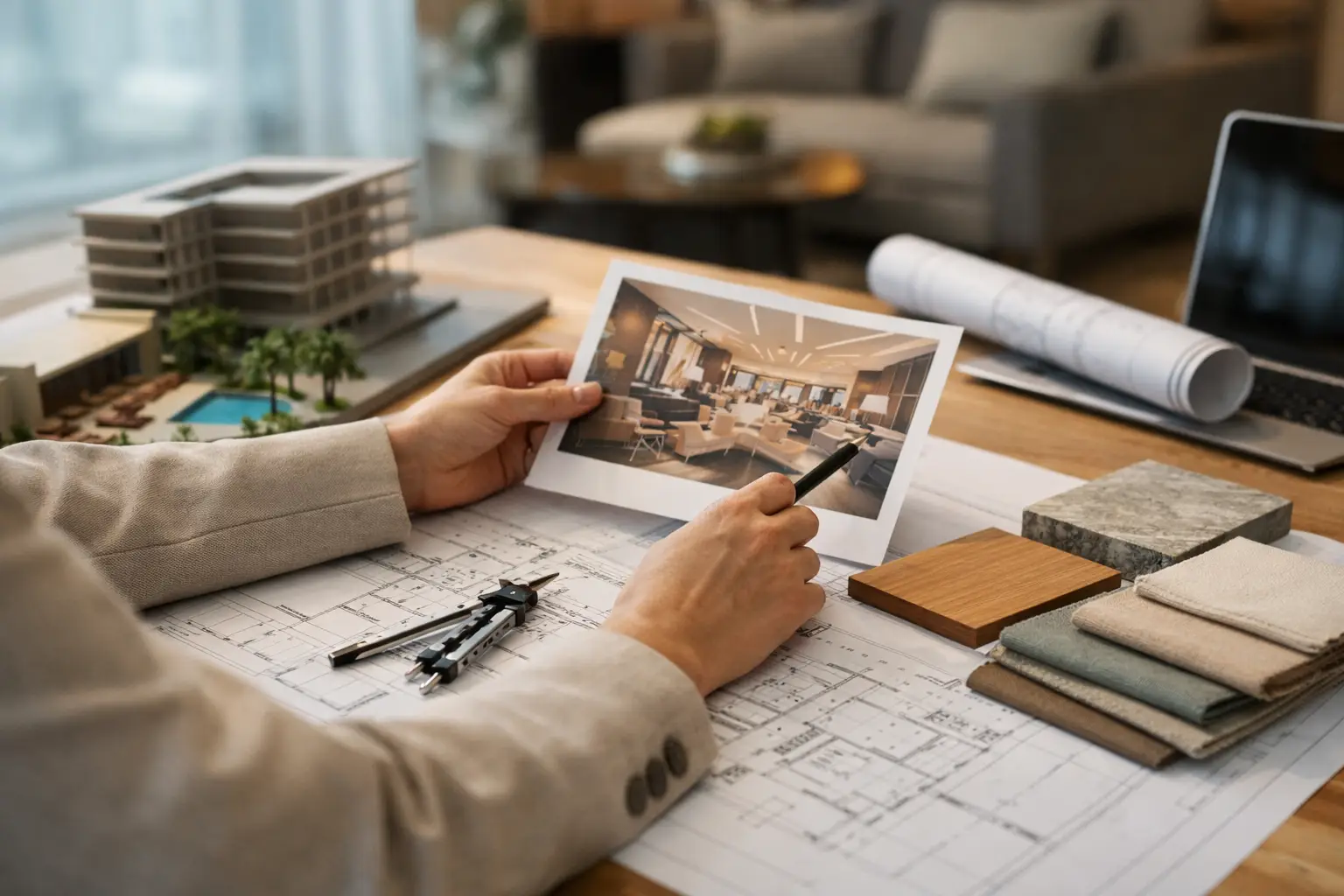
A hospitality project can look commercially promising on paper and still fail in delivery because the design team solved the wrong problems first. In this hospitality project design guide, the real priority is not only aesthetics. It is operational fit, code compliance, authority approvals, and buildability working together from day one.
Hospitality projects carry tighter tolerance for design mistakes than many other commercial fit-outs. A restaurant kitchen that is undersized, a guest circulation path that creates bottlenecks, or an HVAC layout that does not match occupancy loads can affect revenue from the first day of operation. Owners and operators do not need design that simply looks finished. They need design that can be approved, built, and run efficiently.
What a hospitality project design guide should cover
The best hospitality design process starts by aligning brand intent with operational reality. That sounds obvious, but many projects lose time because concept development begins before the project team has defined service model, peak occupancy, back-of-house requirements, utility demand, or approval constraints. In hospitality, those inputs are not secondary details. They drive the layout.
For a boutique hotel, that may mean balancing guest experience with service access, housekeeping flow, fire life safety, and MEP coordination. For a restaurant or cafe, it usually means giving equal design weight to front-of-house identity and kitchen performance. If the concept is strong but the service routes are inefficient, labor costs rise and customer experience suffers.
A useful guide should also account for the fact that hospitality spaces are highly interdependent. Architecture, interior design, structural needs, kitchen planning, ventilation, drainage, electrical loads, and fire protection cannot be treated as separate tracks. Fragmented design creates approval delays and site conflicts. Coordinated design reduces rework.
Start with the business model, not the mood board
Owners often begin with visual references, and that is understandable. Hospitality is customer-facing, and the environment matters. But design decisions become much stronger when they follow the business model rather than lead it.
A quick-service restaurant, an all-day dining concept, and a fine dining venue may occupy similar square footage but require very different planning logic. Seating density, table turnover, prep zones, storage needs, grease management, staff routes, and acoustic expectations all change. The same is true in hotels. A business hotel, resort property, and serviced apartment development each create different demands on reception, amenities, housekeeping, MEP systems, and vertical circulation.
This is where discipline early in the project saves money later. Before design is advanced, owners should have clarity on target guest profile, service style, revenue model, staffing assumptions, and operating hours. Without that, the project risks expensive revisions after authorities review the plans or after contractors begin procurement.
Site conditions and authority requirements shape the design
Every hospitality concept must fit the realities of the site. Access points, parking, utility connections, structural grid, tenancy restrictions, shell-and-core conditions, and landlord requirements can all affect feasibility. So can local authority requirements related to egress, fire safety, food service operations, sanitation, and mechanical systems.
This is where many project schedules begin to slip. A concept may be viable in commercial terms but still require redesign if the site does not support exhaust routing, grease waste handling, occupancy targets, or required service access. The earlier these constraints are tested, the stronger the project control.
For projects in regulated environments such as Qatar, design should be developed with approval strategy in mind from the start. A coordinated submission that reflects authority expectations is not a paperwork exercise. It is a scheduling decision. Teams with direct experience in approvals, permit documentation, and multidisciplinary coordination generally reduce both review cycles and site disruption.
The hospitality project design guide for layout planning
Layout planning is where commercial intent becomes measurable. In hospitality projects, square footage alone is a poor planning tool. What matters is how effectively that area supports service delivery, customer comfort, and compliance.
Front-of-house should be planned around guest movement, visibility, dwell time, and service access. The best layouts make service feel effortless, even when operations behind the scenes are complex. Entrances, waiting areas, seating clusters, restrooms, and payment points must feel intuitive. If customers are crossing server routes or crowding entry thresholds, the design is not finished.
Back-of-house deserves equal attention. Storage, prep, dishwashing, waste handling, staff changing areas, housekeeping rooms, and maintenance access are often compressed to preserve revenue-generating space. That trade-off can work up to a point, but undersized support areas tend to create daily friction that operators pay for repeatedly. Good planning protects the operating model, not just the opening-day impression.
Hotels require another layer of discipline because public areas, guest rooms, service functions, and life safety provisions all interact vertically as well as horizontally. A minor planning compromise on one floor can affect risers, plant space, housekeeping routes, and maintenance access across the entire building.
Engineering coordination is not a late-stage task
In hospitality, MEP systems are not hidden technical layers that can be adjusted after the design is set. They are core to performance. Kitchen exhaust, make-up air, cooling loads, hot water demand, drainage gradients, gas systems where applicable, lighting controls, fire alarm integration, and emergency systems all influence the design from an early stage.
Restaurants are especially sensitive to this issue. An attractive dining room means little if the kitchen overheats, odors migrate into guest areas, or power distribution does not support equipment loads. Hotels face similar pressure in different ways. Guests may forgive modest room sizes, but they rarely forgive poor air distribution, acoustic leakage, or unreliable hot water.
The trade-off is usually between design freedom and engineering practicality. Feature ceilings, decorative lighting, compact service zones, and ambitious kitchen layouts can all be achieved, but only if coordinated early. When engineering is pushed too far back, the result is often either a compromised concept or costly redesign.
Budget control depends on design decisions made early
Hospitality owners tend to focus on construction pricing when discussing budget control. That is only part of the picture. Most budget risk is established during planning and design.
Material selections, kitchen strategy, MEP complexity, structural interventions, facade changes, and authority-driven revisions all affect cost long before tendering begins. A project can appear under control at concept stage and still exceed budget if the design team has not tested critical systems, phasing requirements, or site limitations.
Value engineering is useful, but only when it is strategic. Removing visible finishes late in the process may save upfront cost while weakening brand perception. Simplifying MEP distribution, rationalizing wet-area stacking, reducing custom fabrication, or optimizing back-of-house layouts often produces better savings with less operational damage. The right decision depends on the type of venue, expected customer spend, and lifecycle priorities.
Documentation quality affects speed on site
A hospitality design package should do more than secure approval. It should give contractors enough clarity to price accurately and build without constant interpretation. Weak documentation creates variation orders, procurement errors, and coordination disputes.
That is particularly risky in fast-track fit-outs where opening dates are tied to leasing commitments, staffing schedules, or seasonal demand. In those cases, incomplete drawing sets create the illusion of speed while actually increasing delivery risk. Precise documentation usually moves the project faster because key decisions are made before procurement and site execution begin.
This is where a single-source consultancy model can offer practical advantages. When architecture, civil, MEP, and approval coordination are managed in one workflow, drawing conflicts are easier to resolve before they reach the field. Firms such as Desentral Engineering Qatar are structured around that integrated approach because it reduces fragmentation at the point where most project delays begin.
Choosing the right project path
Not every hospitality project needs the same level of design development. A premium hotel, a branded restaurant rollout, and a small cafe conversion each justify different investment in concept work, custom detailing, and engineering depth. The right path depends on brand ambition, timeline, regulatory exposure, and operating complexity.
What should not change is the need for disciplined coordination. Owners get better outcomes when the design team understands approvals, operations, engineering, and construction as one delivery process rather than separate consultant tasks. That reduces blind spots and gives project stakeholders clearer control over time, cost, and compliance.
A good hospitality project is rarely the result of one bold design move. It is usually the result of many correct decisions made early, documented clearly, and carried through without losing operational intent. That is what protects both opening day and long-term performance.
If you are planning a hospitality project, the most useful question is not whether the concept looks right. It is whether the design is ready to operate, ready to approve, and ready to build without avoidable surprises.